


Publication Project Africa Yearbook
Research Group on African Development Perspectives Yearbook
International Call for Papers Volume 24/2024/2025: “Fiscal Capacity and Resource Mobilization in Africa – New Strategies and New Instruments” (PDF: International Call Volume 24)
“Thirty Years (1989 - 2019) of the African Development Perspectives Yearbook – Impacts on Policy Reforms in Africa”: Access for Download: https://doi.org/10.26092/elib/449, and via PDF: Wohlmuth Festschrift Thirty Years.
WIKIPEDIA, The Free Encyclopedia, Entry about the African Development Perspectives Yearbook (see the link below):
http://en.wikipedia.org/wiki/African_Development_Perspectives_Yearbook
Research Group on African Development Perspectives Bremen
Editors of the African Development Perspectives Yearbook/Redaktion des African Development Perspectives Yearbook:
Scientific Coordinator/Volume Editor for the African Development Perspectives Yearbook: Prof. Dr. Karl Wohlmuth (in office since 1989, Volume 1)
Professor Emeritus Dr. Karl Wohlmuth, Director of the Research Group on African Development Perspectives Bremen
Address:
Professor Emeritus Dr. Karl Wohlmuth,
University of Bremen,
Faculty of Economics and Business Studies,
P.O. Box 330 44,0
D-28334 Bremen, Germany
Phone and Email Addresses:
Phone: +49 (0)421-218-66517
E-Mail:
wohlmuth@uni-bremen.de
iwimsek@uni-bremen.de
Managing Editor of the African Development Perspectives Yearbook: Professor Dr. Tobias Knedlik (in office since 2010, Volume 15, 2010/2011)
Professor Dr. Tobias Knedlik,
Dean, Department of Business, Fulda University of Applied Sciences,
Professor for International Economics, and
Research Professor, Halle Institute for Economic Research (IWH)
Address:
Professor Dr. Tobias Knedlik,
Fulda University of Applied Sciences, Department of Business,
Leipziger Str. 123
D-36037 Fulda
Germany
Phone and Email addresses:
Phone: +49 (0)661 / 9640 - 2801
E-mail: Tobias.Knedlik@w.hs-fulda.de
Book Reviews/Book Notes Editor of the African Development Perspectives Yearbook: Prof. Dr. Samia Satti Osman Mohamed Nour (since 2020, Volume 22)
Prof. Dr. Samia Satti Osman Mohamed Nour,
Full Professor of Economics, Economics Department, Faculty of Economic and Social Studies, Visiting Professor of Economics and Research Fellow, CSAE, Department of Economics, University of Oxford, United Kingdom; Guest Researcher, The Nordic Africa Institute (NAI), Uppsala, Sweden; Affiliated Researcher, UNU-MERIT - Boschstraat 24, 6211 AX Maastricht, Maastricht, The Netherlands; Affiliated Research Fellow, African Studies Centre Leiden (ASCL), Leiden University, Leiden, The Netherlands; and Affiliated Research Fellow Economic Research Forum for the Arab Countries (ERF), Cairo, Egypt.
Postal and Email Address:
Khartoum University, P. O. Box 321, Khartoum 11115, Sudan
E-mail: samia_satti@hotmail.com, samiasatti@yahoo.com; samiasatti78@gmail.com
In einem neuen Beitrag von Professor Karl Wohlmuth für die Sudan-Reihe des IWIM mit dem Titel „Wie kann der Konflikt im Sudan durch friedenstiftende Politiken und durch nachhaltig wirkende Reformen beendet werden?“ wird auf die Hintergründe der militärischen Auseinandersetzungen im Sudan seit dem 15. April 2023 eingegangen (vgl. zum Text der neuen Studie: PDF). Am 15. April 2023 begann die militärische Auseinandersetzung zwischen der SAF (Sudanese Armed Forces) und der RSF (Rapid Support Forces). Die beiden Militärführer und Generäle Burhan und Dagalo, die gemeinsam den Putsch gegen Präsident Al-Bashir im April 2019 durchführten, kämpfen nun um die militärische Vorherrschaft im Sudan. General Dagalo akzeptiert nicht die Unterordnung der RSF unter die SAF von General Burhan. Beide Armeeführer sind auch gegen eine Aufarbeitung des Erbes von den 30 Jahren der Herrschaft von Präsident Al-Bashir und seiner National Congress Party (NCP) im Sudan. Beide Armeeführer vereinte nach der Absetzung von Al-Bashir die Befürchtung, von einer konsequent agierenden Zivilregierung entmachtet und von ihren Besitztümern und Einkommensquellen enteignet zu werden. Vor dem Abkommen über eine von Militärs und Zivilisten gemeinsam getragene Übergangsregierung im Juli 2019 gab es am 3. Juni 2019 ein Massaker, verursacht durch die RSF, unter den Demonstranten, darunter vielen Frauen, die eine Zivilregierung durchsetzen wollten. Beide Armeeführer lehnten von Anfang an eine starke Beteiligung der Zivilgesellschaft an einer Übergangsregierung ab; sie fürchteten um ihren lukrativen Einfluss auf viele sudanesische Unternehmen (ob in Staatsbesitz oder in privater Hand) und auf die natürlichen Ressourcen des Sudan (Gold, andere Mineralien, Grund und Boden, etc.). Aber es waren auch Besorgnisse, für ihre militärischen und die Menschenrechte verachtenden Aktionen im Auftrag von Al-Bashir zur Verantwortung gezogen zu werden. Zudem sahen sich beide Armeeführer als wichtige Ansprechpartner für die Regierungen der Nachbarländer, der regionalen Player und der Global Player. Dazu kommt, dass General Burhan und die SAF auf der einen Seite und General Dagalo und die RSF auf der anderen Seite sich immer deutlicher hinsichtlich der Herkunft, der Ideologie und der Unterstützerkreise unterschieden. Es ging bei General Burhan immer stärker auch um die Rolle der traditionellen Eliten im Niltal und der Islamisten in der Armeeführung und um die Position der Anhänger des Ex-Präsidenten Al-Bashir und der National Congress Party (NCP). Bei General Dagalo ging es zunehmend um die Führungsrolle beim Militär, um die Integration der arabischen Milizen, um lukrative ökonomische Positionen und um die Beteiligung der Peripherie des Sudan an der politischen Machtverteilung. Diese Auseinanderentwicklung zwischen den beiden Armeeführungen beeinträchtigte zunehmend die Verhandlungen mit den verschiedenen Parteien und Akteuren der Zivilgesellschaft und führte letztlich auch zu den militärischen Auseinandersetzungen seit April 2023.
Die bewaffneten Konflikte im Sudan verbreiten sich von der Hauptstadt Khartum in die Peripherie des Landes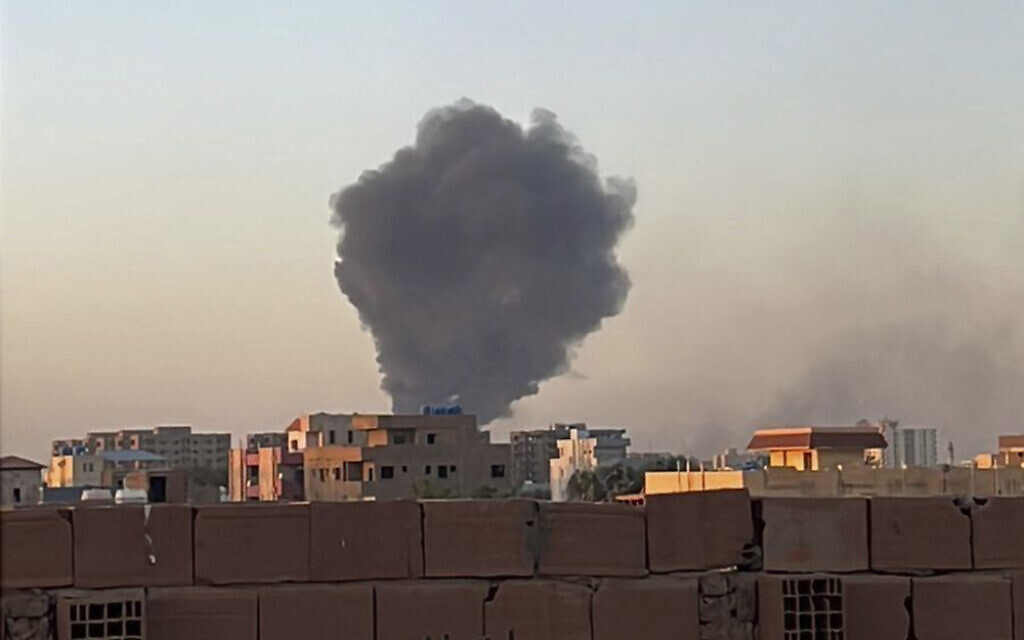
Description of the photo: In this photo provided by Maheen S., smoke fills the sky in Khartoum, Sudan, near Doha International Hospital on April 21, 2023. (Maheen S via AP)
Quelle: Why the conflict in Sudan matters to the rest of the world, The Times Of Israel, 22 April 2023; Link: https://www.timesofisrael.com/why-the-conflict-in-sudan-matters-to-the-rest-of-the-world/
In diesem Beitrag werden wichtige Etappen der Entwicklung im Sudan seit April 2019 diskutiert, um zu verstehen, welche Kräfte seither innerhalb des Militärs und innerhalb der Zivilgesellschaft präsent sind und dominieren. Die Studie zeigt auch auf, dass die Zerklüftung der Zivilgesellschaft ein Problem ist, das schon vor der Unabhängigkeit des Sudan bestand und seit der Unabhängigkeit des Sudan im Jahre 1956 immer bestimmender geworden ist. Es ist daher dringend notwendig, zu fragen, wie ein neues und produktives Verhältnis zwischen dem Militär bzw. dem Sicherheitsapparat einerseits und der zerklüfteten Parteienlandschaft und Zivilgesellschaft des Sudan andererseits gefunden werden kann. Nach der „Sudanesischen Revolution“ des Jahres 2019 mit dem Sturz von Al-Bashir und den Ereignissen im Sudan bis 2023 fragt sich, wie ein politischer Prozess im Sudan aussehen kann, der zur Dominanz der Zivilgesellschaft gegenüber den Militärs in einer zukünftigen Regierung führen kann. Es zeigt sich, dass bisher interne und externe Kräfte immer wieder so im Sudan zusammenwirken, dass Reformschritte abgebrochen und Friedensinitiativen konterkariert werden.
Bibliographische Informationen:
SERG (Sudan Economy Research Group) Discussion Papers, IWIM, Herausgeber der Reihe: Professor Karl Wohlmuth; Link zur SERG-Discussion Papers-Reihe: http://www.iwim.uni-bremen.de/sudan_economy_research_group/
Publikation: Heft Nummer 45, Juni 2023, Autor: Karl Wohlmuth, Universität Bremen:
Wie kann der Konflikt im Sudan durch friedenstiftende Politiken und durch nachhaltig wirkende Reformen beendet werden?
Von: Karl Wohlmuth, Universität Bremen, Juni 2023
Download: PDF
Good news from the Research Group on African Development Perspectives Bremen. Volume 23 of the African Development Perspectives Yearbook with the theme “Business Opportunities, Start-ups and Digital Transformation in Africa” was now released by LIT Publisher (see the link to the African Development Perspectives Yearbook: http://www.iwim.uni-bremen.de/index.php?content=345&lng=de). This edition contains a Unit on Digital Transformation, Digital Entrepreneurship, and Digital Business Opportunities in Africa – General Issues, a Unit on New Business Opportunities created by the Digital Transformation in West Africa, a Unit on Digital Transformation in South Africa with Examples from the Free State, and a Unit on Book Reviews and Book Notes. While volume 24 is more focussed on the macroeconomic policy side of African countries, the volume 23 is related to microeconomic issues in African countries, especially digital entrepreneurship. The African Development Perspectives Yearbook was transformed some time ago to an open access edition and to a fully peer-reviewed publication. It is considered as the leading English-language annual on Africa in Germany. LIT Publisher intends to launch the book at the ninth ECAS (European Conference On African Studies) meeting in Cologne on African Futures, held at 31 May – 3 June 2023. The Book Exhibit at ECAS Cologne 2023 has the link: https://ecasconference.org/2023/exhibit. It is interesting to note that prior to the volume 23 on Digital Entrepreneurship the Research Group on African Development Perspectives Bremen has published two volumes of the Yearbook on topics of entrepreneurship and private sector development in Africa: Vol. 9 (2002/2003): African Entrepreneurship and Private Sector Development, and Vol. 10 (2004): Private and Public Sectors: Towards a Balance. These two volumes were well received and led to important policy discussions. The Festschrift for the African Development Perspectives Yearbook contains a lot of additional information about the philosophy and the working modalities of the Research Group on African Development Perspectives; see the link: https://media.suub.uni-bremen.de/handle/elib/4652?locale=de, and for the direct download: https://media.suub.uni-bremen.de/bitstream/elib/4652/1/Wohlmuth-Festschrift.pdf.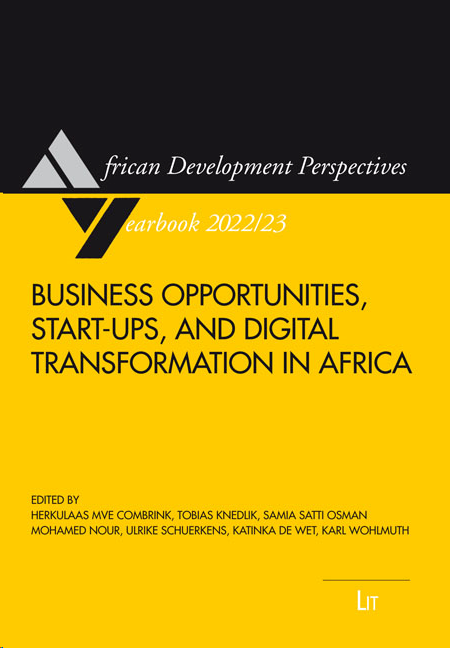
Cover des neuen Bandes des African Development Perspectives Yearbook Volume 23, 2022/23
Quelle: LIT Verlag mit dem Link: https://www.lit-verlag.de/isbn/978-3-643-91441-5
The publishing work for the African Development Perspectives Yearbook goes on. The editors of Volume 24 of the African Development Perspectives Yearbook could close successfully the Call for Papers for this new publication project. Guest Editors and Authors submitted their Proposals and Abstracts on the theme “Strengthening the Fiscal Capacity and Using new Tools and Strategies for Domestic Resource Mobilization of African Countries”. After a rigorous selection of submissions we have secured now enough material to publish a Unit on General Issues of Fiscal Capacity, a Unit on Comparative Analyses of Fiscal Capacity for Selected African Countries, Units on the Fiscal Capacity and Resource Mobilization in Senegal and in Sudan, and a Unit on Book Reviews and Book Notes. We will then have five Units in volume 24 of the African Development Perspectives Yearbook, guided by Guest Editors and the Editorial Staff:
Unit 1: General Issues on Fiscal Capacity and Fiscal Policy in Africa (Unit Editors: Guest Editor/Karl Wohlmuth)
Unit 2: Country Case Studies on Fiscal Capacity and Resource Mobilization in Africa (Guest Editor/Karl Wohlmuth)
Unit 3: Fiscal Capacity and Resource Mobilization in Senegal (Guest Editors)
Unit 4: Fiscal Capacity and Resource Mobilization in Sudan (Samia Nour/Karl Wohlmuth)
Unit 5: Reviews and Book Notes (Samia Nour/Karl Wohlmuth)
The research teams for the Units and Contributions are now working on their first drafts. The first draft and then the final draft will be peer-reviewed and assessed if suitable for the new African Development Perspectives Yearbook volume. The basic idea behind the theme is to investigate the constraints of domestic resource mobilization in times of multiple crises in Africa, because of the climate crisis, the Corona crisis, the crisis caused by the Russian war of aggression against the Ukraine, the global food and energy crises, the crises of global inflation and slowing growth, and the many other crises because of natural disasters and catastrophes. In times of a transition to a new world order since the Joint Declaration of China and Russia on February 4, 2022, there is a vital need to look deeply at the domestic base of fiscal resources and to assess carefully if it is sustainable, expandable, and manageable along the sustainable development goals (SDGs) of the Global Agenda 2030.
Professor Karl Wohlmuth has published an essay on the Russian War of Aggression against the Ukraine and on the implications for the world economy and the world order. In five parts key issues are discussed: the role of innovative sanctions coalitions against Russia; the financing of the Russian war via illegal transnational non-state actors, like the Wagner Group which is operating in resource-rich African countries and fighting in the Donbass region of Ukraine; the impacts of the war on the global political economy and for the establishment of a new world order; three groups of action programmes to control the illegal transnational non-state actors, to compensate the Global South for the collateral damages of the war, and to address the severe losses for the seventeen sustainable development goals (SDGs) due to the war; finally, the impacts of the war and of the Joint Declaration of Russia and China from February 4, 2022 on a new world order are assessed, with a focus on Germany and Europe in regard of the “Zeitenwende”. Also, a blog was published in various versions to look at the role of the Wagner Group in resource-rich African countries, and their tools for the illegal financing of the Russian war in the Ukraine via gold exports from Sudan to fill the foreign exchange reserves of Russia.
The recent research activities on Sudan and South Sudan should be mentioned. The two country-information essays by Professor Karl Wohlmuth on “Sudan” and “South Sudan” which are published in a Handbook on the Near East and Northern Africa were well received by the readers. These are essays which focus on various dimensions (history, economy, society, politics, culture, governance, and the international relations) of the two countries. On Sudan, Professors Karl Wohlmuth and Samia Mohamed Nour have jointly started a research cooperation on the “New Macroeconomics for Sudan in Times of Global Multiple Crises” towards a Unit on Sudan’s economy for the next volume 24 of the African Development Perspectives Yearbook. This research will be part of the volume 24 of the African Development Perspectives Yearbook with a focus on “Strengthening the Fiscal Capacity of African Countries”. Professor Samia Nour has reported for the Sudan Economy Research Group (SERG) of IWIM about her immense research activities on Sudan and the Arab world. Professor Karl Wohlmuth has considered the case of Sudan also in his new working papers and blogs about the Russian War of Aggression against the Ukraine; military and militia leaders of Sudan have exchanged domestically mined gold for weapons and support from the Wagner Group to consolidate their autocratic regime after the coup of October 2021 against the civil side of the government. The blog by Karl Wohlmuth on “Putin, the Wagner Group, the gold of Sudan, and the sanctions on Russia” has received great interest; many colleagues from universities and institutes, such as from the LMU Munich, responded with deep comments and interesting questions, and gave recommendations for further research work.
Professor Karl Wohlmuth was invited under the “Indo-German Joint Research Collaboration” for a research and teaching visit to the Central University of Punjab, India. Professor Wohlmuth is planning a cooperation with researchers from Indian universities for a further volume of the African Development Perspectives Yearbook with the theme “Africa’s Development and the Transitions in the Global South”. A cooperation with Dr. Aydin Findikci, a lecturer in Munich and former student from Bremen University, is intended to publish a report on the “Economic Policies and Strategies for Turkey of the Recep Tayyip Erdogan Autocratic Government”. Professor Karl Wohlmuth was nominated in 2022 by the Falling Walls Foundation Breakthrough of the Year programme which is managed by the Falling Walls Foundation in Berlin. Professor Karl Wohlmuth was invited by Professor Dr. Jutta Günther to attend her Inauguration Meeting to take over the position of a University President (Rektorin) of the University of Bremen on September 6, 2022 at 18:00 pm. Professor Dr. Jutta Günther is working towards the establishment of the University of Bremen as a “Climate University”. As climate policy action is a focus of research in most of the faculties, there is a huge potential for interdisciplinary work. This work is a basic principle since the start of the University of Bremen in 1971. Political representatives from the Freie Hansestadt Bremen (Free Hanseatic City of Bremen) attended the inauguration. The Keynote Lecture was therefore on the theme “Global Value Chains and Climate Change”. In an Open Letter on Science Cooperation seventy (70) experts doing researches in cooperation with partners in the Global South (also Professor Karl Wohlmuth) have requested new forms of science cooperation between German funding institutions, the German research partners, and the researchers/research institutes in the Global South. Too often the science cooperation with the Global South is limited by bureaucratic requirements and legal constraints, and also by the lack of direct funding of researchers/research institutions in the Global South. As Professor Karl Wohlmuth had a lot of such cooperations with research institutions in Africa, supported by DFG, DAAD, FES, Federal and State Ministries, Peace Foundations, Volkswagen Foundation and Alexander von Humboldt Foundation, he shares the critical views in the Open Letter and thinks that it is necessary to reflect continually on the forms and modalities for an innovative scientific cooperation with research institutions and researchers in the Global South. The Open Letter seems now to get something moving in Germany.
Attending Virtual Conferences – On the Russian War of Aggression against the Ukraine, on Climate Change and Adaptation, on Key Technologies, and on Transition and Development Issues: Professor Karl Wohlmuth was invited to various virtual conferences by the OECD Berlin Centre (on topics such as climate policy, employment in Central and Eastern Europe, key technologies in Germany and Europe, trade as a driver for resilient and sustainable supply chains, trade policy in challenging times, industrial subsidies and levelling the playing field, and skills shortages and real wages under pressure), by the wiiw/Wiener Institute für Internationale Wirtschaftsvergleiche (on topics such as developments in Central and Eastern Europe), by the Life & Peace Institute/LPI (on issues such as the impacts of the African Continental Free Trade Area/AfCFTA on the Horn of Africa), by the BEN/Bremer entwicklungspolitisches Netzwerk e. V. (on topics such as choosing of producing feed or food), by the HWWI/Hamburgisches WeltWirtschaftsInstitut (on issues such as structural change and sustainability in the context of crises in Northern Germany and the prospects of the world economy in 2023), by the organizers of the Godley-Tobin Memorial Lecture given by Paul Krugman (on The enduring relevance of Tobinomics), by the Instituto Cervantes (on hopes for a better future of Nicaragua), by the Schader-Stiftung: Darmstädter Tage der Transformation 2022 (on the Socio-economic transformation of our society towards sustainable development), by the FES (on topics such as taxes in times of crises, policies against the global inflation, and on global supply chain issues), and by the DIE/IDOS, and the DIE/IfW (with topics such as up-scaling co-benefits of sustainable consumption for development, charting a roadmap towards deep decarbonization, and Africa’s regional and global integration, with lessons from the past and implications for the future). Especially important were the many conferences by the OECD Berlin Centre on the Russian War against the Ukraine, to look carefully at the economic consequences for Europe and the World Economy, at the impact of the sanctions on the growth of Russia and the world economy, at the overall growth, social and environment effects of the war, at the effects of the refugees moving from Ukraine to Western Europe, at the military and economic developments in the whole NATO area, and at the perspectives of the new world order after the end of the war. Very relevant to our researches and timely was the invitation by the Schader Foundation to take part at the Schader-Forum “Energiepolitik in Zeiten des Krieges” (Energy Policy in Times of War) on October 28, 2022 in Darmstadt.
The editors of Volume 24 of the African Development Perspectives Yearbook could close successfully the Call for Papers. Guest Editors and Authors submitted their Proposals and Abstracts on the theme “Strengthening the Fiscal Capacity of African Countries”. After a rigorous selection of submissions we have now enough material to publish a Unit on General Issues, a Unit on Comparative Analyses of selected African Countries, Units on Senegal and on Sudan, and a Unit on Book Reviews and Book Notes. The research themes are now working on their first drafts. The first draft and the final draft will then be reviewed and assessed if suitable for the new Yearbook volume. Meanwhile volume 23 with the theme “Business Opportunities, Start-ups and Digital Transformation in Africa” is published. This edition contains a Unit on Digital Transformation, Digital Entrepreneurship, and Digital Business Opportunities in Africa – General Issues, a Unit on New Business Opportunities created by the Digital Transformation in West Africa, a Unit on Digital Transformation in South Africa with Examples from the Free State, and a Unit on Book Reviews and Book Notes. While volume 24 is more focussed on the macroeconomic policy side of African countries, the volume 23 is related more to microeconomic issues in African countries. The African Development Perspectives Yearbook was transformed some time ago to an open access edition and to a fully peer-reviewed publication. It is considered as the leading English-language annual on Africa in Germany.
Digital Transformation and the Developmental Role of African Universities – Digital Centres and Digital Futures at Universities in South Africa
In volume 23 of the African Development Perspectives Yearbook a major theme is the digital transformation, its impact on digital business opportunities, and the spread of digital business start-ups in African countries. Various general issues of digital transformation in Africa are covered in the Yearbook to assess the economic and social effects of digitalization, but in two Units of the volume 23 we find country cases of digitalization for Senegal and South Africa. The Interdisciplinary Centre for Digital Futures (ICDF) of the University of the Free State (UFS) in South Africa has contributed with a full Unit to volume 23, and various essays in this Unit highlight the developmental role of the UFS for digital transformation in the Free State and all over South Africa. So, this Unit is of relevance for other universities in Africa as they can learn from the Unit how to contribute to digital transformation.
The UFS is a cooperation partner of the University of Bremen, and the economics faculties and departments of the two universities have a strong cooperation on teaching, training, and research. As the UFS has established some years ago an Interdisciplinary Centre for Digital Futures (ICDF), the innovative aspects of this centre are of wide interest and the role of the centre and of the university for local development can be assessed. In the essays we find valuable information and a discussion about the interactions between the various departments of the university and the economic, social and cultural sectors of the Free State. Projects on digital transformation are related to sectors such as agriculture, health, and education, but also to media, IT, arts and culture sectors.
Essays by the ICDF for the volume 23 of the Yearbook cover three sectors of economic and social development, namely promoting small farmer agriculture, reconstructing the public health sector, and building human capital through progress in the education sector. Projects are assessed and implemented which have a focus on the local settings around the UFS. As the UFS is still in a province with sharp divisions in terms of income levels, poverty rates, schooling conditions, and scores for other social development indicators, the ICDF of the University of the Free State (UFS) can adapt the digital transformation strategies towards the different development levels that exist in the province. And indeed, the ICDF has in focus all these areas of the Free State, such as the agriculture of the poor and the rich peasants, the schooling conditions of the poor and the rich children, and the access to the health system by the poor and the rich citizens. The UFS has - via the ICDF – created digital offers to support local development of diverse social groups. The ICDF is therefore of interest as a model for other African universities.
 Source: UFS; this is the Bloemfontein Campus of the University of the Free State (UFS)
The basic document of the ICDF which is presented in English and in a German translation (see: PDF ICDF Core Document 2023-Original Document and PDF Digital Centre UFS South Africa 2023 - German Translation) has a Vision and is guiding the digital work at the ICDF for the UFS, by integrating the digital research and teaching work of the UFS faculties, by arranging different forms of collaboration with partners in industry and local government, by organising international cooperation projects, conferences and workshops, by looking at local development fields to improve the productivity and the well-being of small farmers and local workers in agriculture, by strengthening the capacity of the education system in poor areas, and by developing the accessibility of the medical systems via e-health offers. The English version of the ICDF Vision is complemented by a version based on a German translation (via Google) to give more access to these fresh ideas. It is of interest to see that the UFS has developed something like a digital centre with local ownership. The ICDF was developed out of the faculties of the UFS, but it can also benefit from analysing what other African countries are doing in this direction.
In Africa, digital centres were established at many universities in various African countries, and universities of the Global North are often involved as well as donor agencies like the World Bank, the AFD and the GIZ (see on the recent initiatives to support digital development centres, digital competence centres, and digital education tools at African universities: https://www.universityworldnews.com/post.php?story=20210714100938827). The Association of African Universities (AAU), which has a membership of about 400 universities, is active on digital development centres and on digital competence centres, supporting digital training and digital research at African excellence universities. The British Council has a programme called the Digital University Africa (see about: https://www.britishcouncil.org/education/he-science/our-work/higher-education-partnerships/digital-university-africa). Centres of Competence in Digital Education are promoted by the AAU-EPFL joint capacity-building initiative. The Association of African Universities (AAU) and the EPFL (École polytechnique fédérale de Lausanne of Switzerland) are implementing the build-up of Centres of Competence in Digital Education (C-CoDE). The Initiative is dependent on inputs from the Global North (see about the C-CoDE initiative: https://ace.aau.org/the-c-code-initiative-kicks-off-to-build-competencies-in-digital-education/). Studies about such digital transformation approaches at universities and about the links to industry and society were done by Professor Karl Wohlmuth; see the numbers 128 and 129 of the Blue Series Discussion Papers of IWIM: http://www.iwim.uni-bremen.de/blaue_reihe/; for the direct download of the numbers 128 and 129 see: http://www.iwim.uni-bremen.de/files/dateien/188_wohlmuth_digital_transformation_africa_layout_blue_series_number_128_9_2019.pdf, and: http://www.iwim.uni-bremen.de/files/dateien/1848_pdf_langfassung_wwc_berichte_wohlmuth_globale_technologieentwicklung_und_afrika_6_2021.pdf. It is of great interest to look at the various approaches which are emerging towards the development of digital competence centres in Africa. The cooperation between the University of Bremen and the University of the Free State in South Africa has a great potential to learn from both sides, from a university in the Global South and from a university in the Global North.
Professor Karl Wohlmuth from the University of Bremen has published a working paper on the Russian war of aggression against the Ukraine and its impacts on sanctions policies of the West, on the economic effects of the war and of the sanctions on the Ukraine and on Russia, on the emergence of private non-state actors (NSAs) at global scale, on the collateral damages in the Global South through the war, and on the effects of the war on the realization of the sustainable development goals (SDGs) of the Global Agenda 2030. The new working paper was published as the number 130 of the Blue Series Discussion Papers of IWIM, and it has a country focus on Sudan as a case study for the role of the Russian Wagner Group in smuggling out the gold mined in the country (see for the number 130 of the “Berichte aus dem Weltwirtschaftlichen Colloquium der Universität Bremen”: http://www.iwim.uni-bremen.de/blaue_reihe/). Professor Karl Wohlmuth has also written a Blog on the activities of the Wagner Group in Sudan since 2017 (see for a download: https://weltneuvermessung.wordpress.com/tag/karl-wohlmuth/). After the Coup of the military and militia commanders of Sudan in October 2021 with the removal of the civil society part of the transitional joint civil-military government, the international community has tried to support the reinstallation of a civilian government in Sudan. There was only a partial success of these efforts up to now, although in December 2022 the military/militia side has agreed to a Framework Agreement to support steps towards a return of a civilian government in Sudan. The recent United Nations Security Council Meeting Report by the Special Representative of the Secretary-General and Head of the United Nations Integrated Transition Assistance Mission in Sudan (UNITAMS) has however highlighted that still some severe obstacles remain to be solved along the path of the Framework Agreement. It is mainly the security sector reform that is an obstacle towards the implementation of the political transition to a civilian government in Sudan (see the latest UN Security Council Meeting Report on Sudan: https://press.un.org/en/2023/sc15236.doc.htm).
Russia and the Wagner Group are still active in Sudan and support the military side, the Sudanese Armed Forces (SAF), and the militia side, the Rapid Support Forces (RSF). As the commanders of these troops are controlling most of the economic sectors in Sudan (manufacturing, mining, trade and other services, commercial agriculture, and land and real estate businesses), a true security sector reform would require a complete removal of these forces from their controlling positions of all these economic sectors. This process is still not in sight (see the analysis of the “Sudanese Revolution” of April 2019 and the implications of the “deep state” in Sudan by Professor Karl Wohlmuth: http://www.iwim.uni-bremen.de/artikel/992/). The obstacles for a democratic control of the economic sectors in Sudan were discussed in a lecture by Professor Karl Wohlmuth (see: http://www.iwim.uni-bremen.de/files/dateien/1819_wohlmuth_buergerbewegung_sudan_mainz_2020.pdf). The next few months up to June 2023 may be important for the Framework Agreement to be accepted or rejected for implementation. Linked to the Framework Agreement is also the Juba Peace Agreement (the agreement of the transitional government of Sudan with various rebel movements in Darfur states, South Kordofan state, Blue Nile state, and in Eastern parts of Sudan); so, the Juba Peace Agreement is also at stake as the rebel movements claim participation rights in their local areas. We find various informed reports on the implementation of the Framework Agreement (in africanews: https://www.africanews.com/2023/01/13/signatories-of-sudans-framework-agreement-meet-to-broker-more-inclusive-peace-deal/; by the European Union Delegation to the Republic of the Sudan: https://www.eeas.europa.eu/delegations/sudan/friends-sudan-group-statement-signature-framework-agreement_en; by the Crisis Group: https://www.crisisgroup.org/africa/horn-africa/sudan/critical-window-bolster-sudans-next-government; and by VOA (Voice of America) News: https://www.voanews.com/a/sudanese-officials-to-speed-up-forming-civilian-government/7011102.html). The official spokesman of the Sudanese civil society part of the Framework Agreement outlines the tasks ahead, such as holding conferences to work on constitutional and transitional documents, but there are many civil society groups and individuals in Sudan who are sceptical that the other side on the table will never give up their economic positions and the military power. So, sanctions against the SAF/RSF military groups from Western powers remain still valid as they were since years.
Transitional Justice and Peacebuilding in Sudan – A Panel Discussion by the Life & Peace Institute (LPI) on March 14, 2023
Professor Karl Wohlmuth was invited by LPI to a panel discussion on “Exploring Transitional Justice (TJ) and Peacebuilding in Sudan” (see on the conference programme: PDF Programme Agenda - Panel Discussion onTJ, and on the Biography of the Panellists: PDF Biography of Panel Speakers). The panel discussion presented, according to LPI, the most current evidence and knowledge on the relationship between TJ and peacebuilding; it examined the existing local methods of dispute resolution and reconciliation in Sudan; and it discussed the roles of different actors, including civil society, and their role in supporting the development and implementation of context-specific TJ processes in Sudan. The Life & Peace Institute (see the website about their activities: https://life-peace.org/) is based in Uppsala, Sweden and aims at awareness-raising, information, policy engagement, and research work on the Horn of Africa (covered in a broader definition, including also Sudan and South Sudan). The LPI has a strategic plan for their work (see about the three strategic pillars : https://assets.ctfassets.net/jzxyrkiixcim/4CM46AnhYy1jcDK7I6rXI1/64580c3d7bbbcc5d28bd64252d1563c6/LPI-STRATEGIC_PLAN-Spread-Nov99.pdf). The three strategic pillars are: Inclusive engagement for peace (Strategic Pillar 1), Policy engagement and awareness-raising (Strategic Pillar 2), and Collaborative learning to enhance practice and policy (Strategic Pillar 3). Professor Karl Wohlmuth is since years collaborating with the LPI on Sudan.
Cooperation with Professor Samia Mohamed Nour from the University of Khartoum - On Research Projects and with the Editorial Group of the African Development Perspectives Yearbook
Very intensive is the cooperation with Professor Samia Mohamed Nour from the University of Khartoum. She reported again a great number of research projects and publications and works with the editorial group of the African Development Perspectives Yearbook on volume 24 (2024/2025) to submit to the theme of the volume on “Fiscal Capacity and Resource Mobilization in Africa – New Strategies and New Instruments” a full Unit on “New Macroeconomic Policies in Sudan in times of Multiple Crises”; focus is on the macroeconomic implications of the Post-COVID-19 situation, the Climate Crisis, the Collateral Damages of the Russian War against the Ukraine, the Global Energy and Food Crises, and the Global Inflation. She is also doing since many years her great job as the Editor for Book Reviews and Book Notes of the African Development Perspectives Yearbook. She joined the Editorial Group when working with us on Volume 20 (2018) of the Yearbook with the theme "Science, Technology and Innovation Policies for Inclusive Growth in Africa – General Issues and Country Cases". Volume 24 is now on the theme of identifying, measuring, strengthening, and mobilizing the fiscal capacity of the African countries through deep policy reforms. Professor Karl Wohlmuth and Professor Samia Mohamed Nour are the two editors of the Unit on Sudan; they will cooperate with leading Sudanese researchers on writing key essays about the new macroeconomic policies in Sudan to mobilize the fiscal resources at central, provincial, and local levels which are needed for development in times of multiple crises.
Professor Samia Mohamed Nour reported in February 2023 about her recent Research Activities:
- Nour, Samia (2023), Economic Consultant and Project Leader for the Deutsche Gesellschaft für Internationale Zusammenarbeit (GIZ) GmbH/German Agency for International Cooperation GmbH, GIZ Research Project on ‘Employment and Labour Market Analysis (ELMA) in Sudan’, November 2022 - May 2023.
- Nour, Samia (2023), “Issues of inclusion and capabilities for establishing the knowledge societies and the potential role of open science in the Arab States”, A Consultancy Research Report prepared for the United Nations Educational, Scientific And Cultural Organization (UNESCO), UNESCO Regional Bureau for Sciences in the Arab States, Cairo, Egypt, July 2021 – November 2021, Forthcoming 2023.
- Nour, Samia (2023), “Innovation and Technological Aspects in the Islamic World”, Chapter 3 in ICESCO Consultancy Research Report: “The Possible Futures of the Islamic World in the fields of Education, Sciences, Culture and Technologies”, Islamic World Educational, Scientific and Cultural Organization (ICESCO), headquartered in Rabat, Morocco, April – November 2021, Forthcoming 2023.
- Nour, Samia (2022), ‘The Impact of COVID-19 on Households and Firms in the MENA Region: the case of Sudan,’ Agence Française de Développement (AFD), Research Paper No 250, Agence Française de Développement (AFD), Paris, France, May 2022, pp. 1-60. Link: https://www.afd.fr/en/ressources/impact-covid-19-households-and-firms-mena-region-case-sudan
- Nour, Samia (2022), “South-South Ideas paper on Digital Transformation: South-South Cooperation, Technology and Digital Transformation: the case of Arab Countries”, United Nations Office for South-South Cooperation (UNOSSC) and United Nations Development Programme (UNDP): United Nations Development Programme (UNDP), New York, USA, September 13, 2022, pp.1-68. Link: https://www.ssc-globalthinkers.org/topic/south-south-ideas-cooperation-technology-and-digital-transformation-case-arab-countries; this is a Research Project in collaboration with the Economic Research Forum (ERF) for the Arab countries and Turkey, the United Nations Office for South-South Cooperation (UNOSSC), and the United Nations Development Programme (UNDP) with the title: “South-South Global Thinkers – A Global Coalition of Think Tank Networks for South-South Cooperation (SSC)”, July 2021- July 2022.
- Nour, Samia (2022), ‘The Impact of COVID-19 on the Middle East and North Africa (MENA) Labour Market: The Case of Sudan’, Economic Research Forum (ERF) for the Arab countries and Turkey, Policy Brief Number PB 87, pp. 1-11, August 2022, ERF, Cairo, Egypt; Link: https://erf.org.eg/publications/the-impact-of-covid-19-on-middle-eastern-and-north-african-labor-markets-glimmers-of-progress-but-persistent-problems-for-vulnerable-workers-a-year-into-the-pandemic/.
- Nour, Samia (2022), ‘The Impact of Covid-19 on the Labour Market in Sudan’, The Forum: ERF Policy Portal. October 25, 2022. Link: https://theforum.erf.org.eg/2022/10/25/impact-covid-19-labour-market-sudan/)
- Krafft, Caroline, Nour, Samia, and Mahjoub, Ebaidalla (2022), ‘‘Jobs and Growth in North Africa in the COVID-19 Era: the case of Sudan 2018-2021”, The Forum: ERF Policy Portal. 7 November 2022, Link: https://theforum.erf.org.eg/2022/11/07/jobs-growth-north-africa-covid-19-era-sudan-2018-21/.
- ERF- ILO First Report on Jobs and Growth in North Africa (2021); the report was edited by Prof. Ragui and other colleagues; the project was supported by the International Labour Office (ILO) and the Swedish International Development Agency (SIDA); Professor Nour was pleased to contribute as a co-author to the Sudan Country Chapter. Link: https://www.ilo.org/africa/information-resources/publications/WCMS_809435/lang--en/index.htm
- ERF- ILO Second Regional Report on Jobs and Growth in North Africa (2022); the report was edited by Prof. Ragui and other colleagues; the project was supported by the International Labour Office (ILO) and the Swedish International Development Agency (SIDA); Professor Nour was pleased to contribute as the co-author of Sudan Country Chapter). https://www.ilo.org/africa/information-resources/publications/WCMS_809435/lang--en/index.htm
Important Conferences and Contributions by Professor Samia Mohamed Nour:
She also reported about her participation at the UNECA conference in Marrakech, Morocco (November 1-2, 2022). The ECA Sub-Regional Office for North Africa (SRO-NA) and the ECA Sub-Regional Office for West Africa (SRO-WA) were thankful for her participation in the expert meeting on the theme: "Resilience to crises and sustainability of development in North and West Africa", a conference that was held at the "Four Seasons Hotel" on November 1 and 2, 2022 in Marrakech (Kingdom of Morocco). There will be a report following from this event.
It was a great pleasure for her to participate as an invited Sudanese guest and speaker at the final symposium of the Resilience in Urban Sudan (RUS) research project that was held on 25 - 26 August 2022 at Malmö University, Malmö, Sweden. The RUS project is funded by the Swedish Research Council (SRC) under the Research Project Grant within Development Research. The Invitation to the Conference with the Call for Papers (PDF Malmö University) and the Programme of the Conference (PDF Programme RUS) are attached.
Great interest raised her ERF Policy Brief No. 87, August 2022 (PDF ERF Policy Brief ERF PB 87): “The Impact of Covid-19 on the MENA Labor Market: The Case of Sudan”. It is based on the attached AFD Research Paper (PDF AFD-ERF - Research Paper) entitled ‘The Impact of COVID-19 on Households and Firms in the MENA Region: the case of Sudan’. This paper was conducted in the context of the research project of the Economic Research Forum (ERF) under the Agence Française de Développement (AFD) Programme titled: “The Impact of COVID-19 on Households and Firms in the MENA Region: the case of Sudan”, Number 250, May 2022. The research project was fully supported by a research grant in cooperation with the ERF (Cairo, Egypt) and the Agence Française de Développement (AFD, Paris, France).
In einem neuen Beitrag geht der Bremer Wirtschaftsprofessor und Sudanforscher auf die informellen Netzwerke ein, die Putin nutzt, um die Goldreserven Russlands aufzustocken und so die Sanktionen des Westens zum Teil zu kompensieren (vgl. die PDF: Putin-Sanktionen-8-2022). Für die Entwicklungspolitik gegenüber Afrika ergeben sich wichtige Schlussfolgerungen, insbesondere auch für die Bundesrepublik Deutschland und die Europäische Union. Der Weser-Kurier aus Bremen hat eine Kurzfassung der Studie in der Papierausgabe vom 28. August 2022 auf der Seite 2 mit dem Titel „Putin finanziert Kriege über informelle Netzwerke“ veröffentlicht. Eine Online-Veröffentlichung zu dem Thema erfolgte am 27. August 2022; Zugang unter dem Link: https://www.weser-kurier.de/politik/ausland/putin-finanziert-seine-kriegsoperationen-ueber-informelle-netzwerke-doc7mhlaa9go1e9y7onnfx
Kurzfassung der wesentlichen Thesen:
Putin, die Sanktionen und das Gold Afrikas
Karl Wohlmuth, Universität Bremen
Der Angriffskrieg Russlands gegen die Ukraine dauert nun schon mehr als sechs Monate. Die Europäische Union ist dabei, ein siebentes Sanktionspaket zu schnüren. Doch Putin rühmt die Stärke der russischen Wirtschaft. Im Westen gibt es daher Zweifel an der Wirksamkeit der Sanktionen. Studien zeigen aber, dass Russland überaus wirksamen Sanktionen gegenübersteht. Der Propagandaapparat des Kremls zeichnet ein Bild der Wirtschaftsentwicklung, das durch umfassende Manipulation von Daten zustande kommt. Rosstat, die Statistikbehörde des Landes, wurde dem Propagandaapparat des Kremls eingegliedert. Daten über die Wirtschaftslage werden auf vielfältige Weise manipuliert, etwa durch Prognosen, die sich auf Ausgangsdaten aus den ersten Kriegstagen beziehen oder durch die selektive Präsentation von Datenreihen mit positiven Entwicklungstrends. Die sorgfältige Analyse der offiziellen Daten ergibt ein Bild, das bereits umfassende und auch unumkehrbare Wirkungen der Sanktionen zeigt.
Russland hat bereits wichtige Positionen auf den internationalen Rohstoffmärkten (vor allem bei Gas, Öl, und Kohle) verloren. Die Importabhängigkeit praktisch aller industrieller Wertschöpfungsketten von westlichen Inputs und Technologien bedeutet, dass die Produktionsverluste Russlands größer werden. Die Strategie der Importsubstitution ist schon gescheitert. Der Exodus von wesentlichen Teilen der russischen Produktionsbasis (Unternehmen, Kapital, und Talente) beschleunigt sich. Mehr als 1000 international operierende Unternehmen haben das Land verlassen. Die makroökonomische Politik kann weder die Inflationsbekämpfung noch die Strukturanpassung erreichen. Die Abkoppelung von den internationalen Finanzmärkten führt zu drastischen Veränderungen auf den heimischen Finanzmärkten, da eine lange Dauer des Krieges und eine stabile Sanktionsfront eingepreist werden. Die Sanktionspolitik des Westens ist effektiv, weil ein umfassender Strategieansatz dahintersteht. Expertengremien evaluieren die Wirksamkeit der Sanktionen.
Putin geht nicht von einem Zerbrechen des westlichen Sanktionssystems aus, sondern nutzt informelle Netzwerke, um seine Kriegsoperationen zu finanzieren. Kurz nach der Annexion der Krim im Jahr 2014 hat er den Sudan als „Schlüssel nach Afrika“ ausgemacht, um ein Netzwerk des Goldschmuggels zur Umgehung der Wirkung von Sanktionen zu etablieren. Diese Netzwerke sollen helfen, die Goldreserven der russischen Zentralbank aufzustocken. Die „Gruppe Wagner“, verharmlosend als privates Söldner- und Militärunternehmen bezeichnet, ist nunmehr in 23 afrikanischen Ländern aktiv. Die Gruppe hat die Funktion, Militärregime zu stabilisieren und lokale Armeen auszurüsten; als Gegenleistung werden Russland illegale Einnahmen aus der Überwachung von Bergbauaktivitäten und Anteile aus dem Schmuggel von hochwertigen Mineralien wie Gold zugesichert. Die „Gruppe Wagner“ hat im Sudan ein internationales Netz des Goldschmuggels etabliert; seit dem Putsch vom Oktober 2021 unterstützen die Spitzenmilitärs des Sudan ganz offen dieses „Geschäftsmodell“. Gold im Wert von Milliarden Dollars wird – vorbei an staatlichen sudanesischen Stellen und der Zentralbank - aus dem Land geschmuggelt. Dieses Geschäftsmodell wird auch in anderen afrikanischen Ländern praktiziert. Diese informellen Netzwerke sind für die Finanzierung des Ukrainekriegs und anderer Militäroperationen Russlands enorm wichtig geworden. Goldtransaktionen können durch Sanktionen wesentlich schwerer unterbunden werden. Die Sanktionen gegen die „Gruppe Wagner“ durch den Westen sind bisher wirkungslos geblieben.
Für eine neue globale Ordnung ergeben sich bedeutsame Herausforderungen. Bei drei Themen (Stabilisierung einer kooperativen und effektiven Sanktionspolitik bei Angriffskriegen, Ausgestaltung von Politiken für Reparationen und den Wiederaufbau zerstörter Regionen nach dem Ende von Angriffskriegen, Gestaltung einer neuen Sicherheitsarchitektur zur Verhinderung zukünftiger Angriffskriege und zur Vermeidung existenzieller globaler Gefährdungen) besteht offensichtlich ein immenser internationaler Handlungsbedarf. Der Weckruf des Aggressionskrieges von Russland gegen die Ukraine zeigt, dass neben der Klimakrise auch die Gefahren durch nichtprovozierte Angriffskriege neu zu bewerten sind, da die Existenz des Planeten Erde auf dem Spiel steht. Die Finanzierung von Angriffskriegen und Militäroperationen durch informelle Netzwerke und durch illegale Rohstofftransaktionen aus Entwicklungsregionen wie Afrika zeigt auch, dass die Stabilität des internationalen Finanzsystems neu austariert werden muss. Entwicklungsfeindliche „Geschäftsmodelle“, wie von der Gruppe Wagner in Afrika im Auftrag des Kremls praktiziert, wirken deutlich gegen alle 17 Nachhaltigkeitsziele, die 2015 vereinbart wurden.
Seit 1989 wird von Professor Dr. Karl Wohlmuth an der Universität Bremen mit Unterstützung des Fachbereichs Wirtschaftswissenschaft das African Development Perspectives Yearbook herausgegeben. Die Herausgebergruppe hat nun für den Band 24 (2024/2025) das Thema „Fiskalische Kapazität und Ressourcenmobilisierung in Afrika – Neue Strategien und neue Instrumente“ festgelegt. Der Call for Papers (siehe die PDF) enthält alle wichtigen Angaben zu den Inhalten, zur Struktur und zum Zeitplan dieses Projekts.
Die fiskalischen Auswirkungen der multiplen globalen Krisen für Afrika werden analysiert
Die globalen Krisen (COVID-19, Störung der globalen Lieferketten, Klimakrise, Aggressionskrieg gegen die Ukraine, globale Energie- und Lebensmittelkrisen) haben erhebliche Auswirkungen auf die fiskalische Kapazität vieler Länder in Afrika. Die Steuereinnahmen stagnieren schon seit Jahren in Afrika und die Nicht-Steuer-Einnahmen vieler Staaten in Afrika (etwa aus Rohstoffrenten) sind sogar rückläufig. Globale Hilfen können die wachsende Finanzierungslücke nicht decken. Die fiskalische Kapazität kann aber durch diverse Interventionen des Staates um mindestens 10% des Bruttoinlandsproduktes (BIP) erhöht werden: durch die Mobilisierung von Steuereinnahmen und von Nicht-Steuereinnahmen des Staates, durch die Reduzierung von Steuerumgehung und Steuervermeidung, durch neue Verfahren der elektronischen Besteuerung, durch konsequente antizyklische Fiskalpolitiken, und durch eine effizientere Steuerverwaltung. Diese Aspekte sollen im Band 24 des Jahrbuchs in Länder-, Sektor-, Interessengruppen- und Unternehmensanalysen, aber auch in Literaturberichten und in analytisch-methodischen Aufsätzen zu neuen Politiken und Instrumenten diskutiert werden.
Forschungsprojekte des Fachbereichs und der internationalen Kooperationspartner werden einbezogen
Das African Development Perspectives Yearbook hat zwei konstituierende Prinzipien, die die Arbeit der Herausgeber leiten. Erstens werden Beispiele für erfolgreiche Politiken und Programme analysiert, um die Politik und die Entwicklungszusammenarbeit (EZ) anzuregen, diese Erfolgsmodelle auch in anderen Ländern Afrikas umzusetzen. Zweitens wird jeder Beitrag mit einem Strategieteil abgeschlossen, um den Verantwortlichen für die Umsetzung von Politiken Hinweise zu geben wie Reformen erfolgreich durchgeführt werden können. Der Band 22 (für 2020/2021) über „Das Nachhaltigkeitsziel Neun (Infrastruktur, Innovation, Industrialisierung) und Afrikas Entwicklung“ ist im Vorjahr erschienen (vgl. unten das Foto des Covers von Band 22). Der Band 23 (für 2022/2023) über „Digitale Transformation, neue Geschäftsmöglichkeiten und Start-Ups in Afrika“ ist fertiggestellt und bereits in Druck. Prof. Dr. Jörg Freiling berichtet in diesem Band über eine Fallstudie und ein Forschungsprogramm zum Thema „Afrikas transnationale digitale Unternehmen/Unternehmer“. Der Kooperationspartner des Fachbereichs in Südafrika (University of the Free State) steuerte eine ganze Unit (mit fünf Beiträgen) über den Entwicklungsbeitrag des neuen universitären Digital Development Centre der Universität im Free State bei.
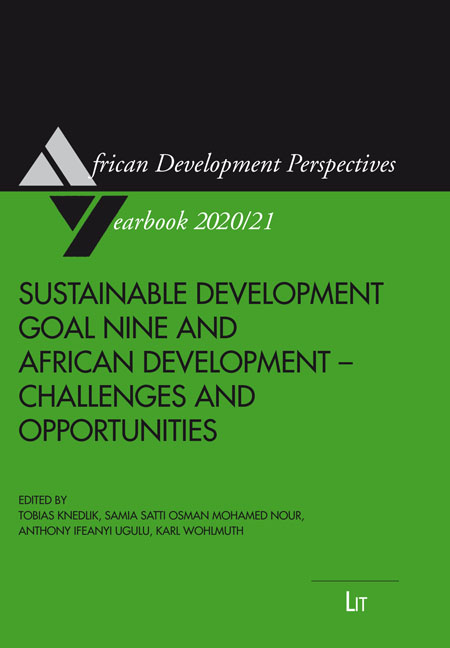
Cover des Bandes 22 (2020/2021) des African Development Perspectives Yearbook
Das African Development Perspectives Yearbook ist eine Peer-Review-Publikation und nun auch eine Open Access-Publikation
Wichtige Ergebnisse der Befragung von früheren Herausgebern und Autoren des Jahrbuchs führten zu wesentlichen Neuerungen in Format und Inhalt, die sich auch bereits im Band 23 finden. Die Festschrift “Thirty Years (1989 - 2019) of the African Development Perspectives Yearbook – Impacts on Policy Reforms in Africa” enthält gewichtige Beiträge von früheren Herausgebern und Autoren und auch Schlussfolgerungen des gegenwärtigen Herausgeberteams; vgl. zu der Veröffentlichung: Zugang zum Download: https://media.suub.uni-bremen.de/handle/elib/4652, und als PDF: http://www.iwim.uni-bremen.de/files/dateien/1837_wohlmuth_festschrift_thirty_years_6_2020_2.pdf. Der erste Band des Jahrbuchs ist 1989 erschienen. Insbesondere für die entwicklungspolitische Diskussion über Afrika und für die politische Umsetzung der Reformen in Afrika sind die Ausgaben des Jahrbuchs von Bedeutung. Das Jahrbuch ist nun das führende englischsprachige Jahrbuch über Afrika in Deutschland.
In recent months, Professor Karl Wohlmuth was busy in various directions. He did various evaluations of research proposals for the Alexander von Humboldt Foundation, specifically for the Georg Forster Research Fellowship Programmes for Experienced Researchers and for the Visiting Research Fellowship Programme of the Centre of African Studies, University of Cambridge, UK, beside of routine evaluations of incoming articles and research proposals. As he was himself a scientific supervisor of Alexander von Humboldt/Georg Forster senior research fellows, he knows the character of these very competitive applications quite well.
Professor Karl Wohlmuth was also involved as an expert in a quite interesting teaching project. His duty was it to give his expert opinion on Kenya in the year 2045. It was the task to review the current situation of Kenya and to give a prognosis about the major trends for Kenya up to the year 2045. It was interesting to learn from the task that Kenya is preparing not only for the digital age but also for managing the impacts of the climate crisis and the long-term effects of COVID-19. All this is done by reviewing and adapting the constitution and the planning procedures of Kenya, the local development and decentralization approaches for the counties in Kenya, and the whole institutional infrastructure of the country so that a knowledge society and a participatory society can emerge in Kenya.
A highlight of the work was the release of volume 22 of the African Development Perspectives Yearbook for the years 2020/2021 on the theme ”Sustainable Development Goal Nine - Challenges and Opportunities”. This Open Access Publication was received with great expectations and huge interest by policymakers in Africa, as it is one of the few publications for giving concrete examples how SDG 9 (on industry, innovation, and infrastructure) can be promoted in Africa. The recommendations worked out from the authors of the Festschrift “30 Years Anniversary of the African Development Perspectives Yearbook (1989 – 2019)” were already taken up and considered in the new issue. Also, the Research Group on African Development Perspectives Bremen did now mostly finalize volume 23 (for 2022/2023) of the Yearbook with the theme “Business Opportunities, Start-ups and Digital Transformation in Africa”. It was a good opportunity to share experiences with so many guest editors, authors, reviewers, and other contributors. The volume is composed of four Units (Parts) and gives new insights on digital transformation, digital entrepreneurship, and new business opportunities arising in this context. There is also a strong Unit with Book Reviews and Book Notes on publications along the theme. The volume is based on country cases and on analytical surveys. The Editorial Committee for the Yearbook has already decided about the focus of volume 24 (for 2024). The title will be: “Fiscal Capacity and Resource Mobilization in Africa - New Strategies and New Instruments”. Covid-19 and the need of financing for mitigating and adapting to the climate crisis have revealed the importance of new strategies for domestic resource mobilization in Africa and of getting to new long-term global financing mechanisms for Africa’s restructuring and development processes.
On Sudan Studies, Professor Karl Wohlmuth has published two essays to highlight for an international Handbook on Near and Middle East Studies the country cases of “Sudan” and “South Sudan”. It was done in an interdisciplinary manner, covering culture, geography, history, economy, and politics of the two countries. There was also an intensified co-operation with Professor Samia Nour, University of Khartoum, Sudan on “COVID-19 and impacts on households and firms in Sudan” and on the “End of the <Sudanese Revolution> on 25 October 2021 after breaking with the regime of Al-Bashir in April 2019 after 30 years”. Professor Wohlmuth did prepare a note for the international press about the event.
New publications were done on the theme of “Comparing Waste Management Policies of Nigeria and Germany – What can the two countries learn from each other” (written together with Professor Reuben A. Alabi from Ambrose Alli University, Ekpoma, Nigeria). A deep analysis resulted which found interest in both countries. The authors have followed for the two countries the same system of classification for the waste management actions and policies which were discussed. Also, a blog was written about the Aggression War by Russia on the Ukraine and what this means for future academic cooperation (together with Professor Axel Sell). The Faculty of Economics and Business Studies of the University of Bremen and IWIM (Institute for World Economics and International Management) had and still has impressive co-operations with universities in the Ukraine.
Professor Wohlmuth did lecture at a conference in Bremen by Development NGOs about “Lessons from the Corona and the Economic Crisis for the African Continent”. The presentation did outline the major twelve (12) lessons which should be considered by policymakers and donors, and definitely also by the community of development researchers. The conference did compare country cases of Africa with country cases of Latin America, but considered also more general issues of the global health crisis and the health crisis in the Global South. A blog was written on the twelve (12) lessons for Africa by Professor Karl Wohlmuth on these issues (in German).
Professor Wohlmuth did participate at numerous other Zoom scientific conferences and launches of new publications. Launches of new studies, presentations of new OECD studies, and workshops on current political, developmental and economic issues show the advantages of virtual meetings. This format may be a good addition to other forms of meetings and presentations (also for Post-COVID times).
At the occasion of the celebration of the “Anniversary after 50 Years of the University of Bremen (1971 - 2021)” Professor Wohlmuth has also contributed to the Festschrift prepared by the Faculty of Economics and Business Studies of the University of Bremen. He was one of the first professors appointed in 1971 for the research and teaching field of “Comparative Economic Systems”. There was a huge programme placed for the year 2021 to celebrate the anniversary in the City of Bremen and at the Campus. The University of Bremen started in 1971 with various interesting and highly important experiments (interdisciplinary research and teaching, orientation towards practical application of theoretical reasoning, fair participation of all stakeholders at the university, strong focus on Third World issues, teaching the understanding of the evolution of the current socio-economic system in all faculties, and new forms of organizing the university through collective and participatory meetings and decision-making).
Professor Samia Nour from the Economics Faculty of the Khartoum University in Sudan has done important research on the economic impacts of COVID-19 in her country. Her report “The Impact of COVID-19 on Households and Firms in the MENA Region: the case of Sudan” is part of an ERF (Economic Research Forum) Research Project: “The Impact of COVID-19 on Households and Firms in the MENA Region”, and it allows comparative analyses for MENA Region countries. Professor Nour supports the Sudan Studies at Bremen and is Book Reviews and Book Notes Editor of the African Development Perspectives Yearbook. Professor Nour will provide for a short Policy Brief version of the study for the SERG Discussion Papers at IWIM.
Professor Samia Nour writes about the content of her study (see the full study for download: Sudan Final Revised Draft – The Impact of COVID-19): “This paper discusses the impacts of COVID-19 on households and firms in Sudan as a case study of the MENA countries. The research applies descriptive and comparative approaches and uses new primary data obtained from the ERF (Economic Research Forum) COVID-19 MENA Monitor Household Survey (2021) and from the World Bank and Sudan Central Bureau of Statistics High Frequency Survey on COVID-19 (2020). Our results with data from the World Bank Survey on COVID-19 (2020) show the impact of COVID-19 on the employment status that appears from the loss of jobs for the majority and nearly two thirds of households during June – July 2020. We explain that the main reason for the households‘ loss of jobs, additional unemployment, and even the change of jobs was because of business / government closures due to coronavirus legal restrictions. The impact of COVID-19 also appears from the loss of payments for nearly a fifth of households, the loss of partial payment for nearly half of households, and the loss and the reduction of households‘ means of livelihood or sources of income since mid-March 2020 from non-farm family business, income from properties, investments or savings, and income from family farming, livestock or fishing. The impact of COVID-19 on micro, small and medium size enterprises appears to result from temporary or permanent closures of establishments, from substantial decreases in sales, or from stagnation in sales.
Our results from the ERF COVID-19 MENA Monitor Survey data (2021) show the impacts of COVID-19 on the labour market and on the working conditions that appear to result from the increase in temporary or permanent layoffs/suspension of workers, reduced working hours, reduced wage payments, and delays in wage payment for workers in Sudan between April 2021 and August 2021. These results are consistent with the results of other MENA countries. Between April 2021 and August 2021 the delay in wage payments has more than doubled; the temporary layoffs/suspension of workers have increased from nearly a tenth in April 2021 to nearly a fifth in August 2021. In August 2021, the employment status of workers in business indicates temporary layoffs/suspension of workers for nearly a fifth of the workers, while permanent layoffs/suspension of workers had reached nearly a tenth of the workers, and the delays and changes in wage payments had accounted for nearly a quarter of the workers.
Attainment of social insurance decreased from nearly a third of all households in April 2021 compared to nearly a quarter of all households in August 2021. Our results concerning the temporary or permanent closures of business due to factors related to COVID-19, the reduction in business working hours, the challenges facing businesses due to loss in demand, and the declining access to customers due to mobility restrictions in Sudan are consistent with the results across other MENA countries. From policy perspectives our findings indicate that the most common types of support in Sudan were business loans, salary subsidies, and reduced/delayed payment of taxes; these results are also consistent with the results in other MENA countries. Our findings regarding the limited provision of social protection (social insurance) and regarding the importance of supporting social protection for workers in Sudan are consistent with the findings in the other MENA countries. The major policy recommendation is for increasing government support to manage COVID-19 economic and social impacts on workers in Sudan.”
The reports on the impacts of COVID-19 and the following other reports on education, digital transformation, and technological capabilities written by Professor Samia Nour were relevant for policymakers in Sudan and in other MENA Region countries:
1. The United Nations Educational, Scientific And Cultural Organization (UNESCO), UNESCO Regional Bureau for Sciences in the Arab States, Consultancy Research Report “Issues of inclusion and capabilities for establishing the knowledge societies and the potential role of open science in the Arab States”, UNESCO Cairo, Egypt, (July – November 2021) (in Arabic).
2. The Islamic World Educational, Scientific and Cultural Organization (ICESCO), Consultancy Research Report “Innovation and Technological Aspects in the Islamic World”, Chapter 3 in: ICESCO, “The Possible Futures of the Islamic World in the fields of Education, Sciences, Culture and Technologies”, ICESCO, Rabat, Morocco (April – November 2021).
3. Economic Research Forum (ERF) for Arab countries and Turkey, Research Project in collaboration with South-South Global Thinkers – A Global Coalition of Think Tank Networks for South-South Cooperation (SSC), Dubai International Financial Centre (DIFC), “South-South Cooperation - Technology and Digital Transformation in the Arab Countries”, The Economic Research Forum (ERF) for the Arab countries and Turkey (ERF), Cairo, Egypt (July 2021- January 2022).
4. Economic Research Forum (ERF) for Arab countries and Turkey and the Agence Française de Développement (AFD) Programme Joint Research Project, “The Impact of COVID-19 on Households and Firms in the MENA Region: the case of Sudan”, The Economic Research Forum (ERF) for the Arab countries and Turkey (March 2021– January 2022).
5. Economic Research Forum (ERF) for Arab countries and Turkey and International Labour Organization (ILO), “Second Report on Jobs and Growth in North Africa: the Impact of COVID-19 in North Africa: Sudan Country Chapter (2022)”, Advancing the Decent Work Agenda in North Africa (ADWA) (August 2021 – February 2022), as the part of the ERF-ILO ADWA Project (2020-2023). (Co-authors: Caroline Krafft, Samia Mohamed Nour, and Ebaidalla Mahjoub).
6. Economic Research Forum (ERF) for Arab countries and Turkey and International Labour Organization (ILO), “First Report on Jobs and Growth in North Africa: Sudan Country Chapter (2020)”, Advancing the Decent Work Agenda in North Africa (ADWA) (April 2020 – August 2021), as part of the ERF-ILO ADWA Project (2020-2023). (Co-authors: Ebaidalla Mahjoub and Samia Mohamed Nour).
Links to important partners of these projects:
ERF/Economic Research Forum for Arab countries and Turkey: https://erf.org.eg/
ADWA/Advancing the Decent Work Agenda in North Africa: https://www.ilo.org/africa/technical-cooperation/WCMS_673349/lang--en/index.htm
ICESCO/Islamic World Educational, Scientific and Cultural Organization: https://www.icesco.org/en/
AFD/Agence Française de Développement: https://www.afd.fr/fr
SERG Discussion Papers at IWIM: http://www.iwim.uni-bremen.de/sudan_economy_research_group/